Crowns and bridges
A crown protects and rebuilds a damaged tooth; a bridge replaces a missing tooth by resting on the neighbouring teeth.
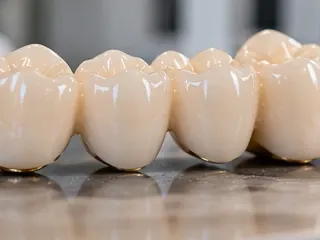
Crown or bridge?
| What it is for | How | |
|---|---|---|
| Crown | Protecting a weakened tooth (large cavity, root canal treatment, fracture). | It covers the whole prepared tooth. |
| Bridge | Replacing one or two missing teeth. | It rests on the neighbouring teeth, which are prepared. |
Who is it for?
- A tooth badly damaged by a cavity or a fracture, which a simple filling can no longer rebuild.
- A root-treated tooth, which has become more fragile.
- An old crown that is worn, loose or unsightly.
- One or two missing teeth, when the neighbouring teeth can act as supports.
What you can expect
A fixed tooth that regains its shape and its function for chewing. The shade and shape are chosen to match the neighbouring teeth.
Treatment generally takes at least two sessions: one to prepare the tooth and take the impression, the other to fit the piece made by the dental laboratory. In between, a temporary tooth protects you.
The steps
- Examination. An X-ray and the choice of solution.
- Written plan and estimate. The chosen solution, the material and the number of sessions, before any decision.
- Preparation and impression. The tooth is prepared; a temporary tooth is fitted.
- Making the crown or bridge. The crown or bridge is made by a dental laboratory.
- Fitting. Trial, adjustment, then cementing.
- Check-up. The gum and your bite are checked some time after fitting.
The alternatives
- A partial restoration of the tooth, if it is still strong enough.
- An implant, to replace a missing tooth without preparing the neighbouring teeth.
- A removable denture, when several teeth are missing.
- A veneer, for a slightly damaged front tooth where only the visible surface needs correcting.
Limits and precautions
- The teeth that carry a bridge are prepared; an implant can avoid this.
- A crown can come loose or crack; check-ups make it possible to monitor it.
- The material (ceramic, porcelain fused to metal, and so on) is chosen according to the tooth and the appearance you want.
- Temporary sensitivity is possible after the tooth is prepared.
- A cavity can develop at the edge of the crown if hygiene is not sufficient.
Care and follow-up
You brush a crown like a tooth. Under a bridge, cleaning calls for a particular technique (an interdental brush or a suitable floss) that the dentist shows you. Regular check-ups make it possible to monitor the edges and the gum.
Cost
It depends on the number of teeth and the material. It is given to you in writing after the consultation.
Frequently asked questions
Does having a crown fitted hurt?
Preparation is usually carried out under local anaesthesia. Temporary sensitivity may follow.
Which material should I choose?
It depends on the position of the tooth, the chewing forces and the appearance you want. The dentist explains the possible options for your case.
How long does a crown last?
It can last a long time if it is well cared for and checked, but no lifespan is guaranteed: hygiene, habits and check-ups all count.
A clinical consultation is needed to determine whether this treatment is right for you.